Ekathep Michaels (Dinsor)
a collective archive of design, research, and my passion
The Standard
Economic Forum
2025 - Young Leaders Dialogue
Young leaders
under 40
November 6, 2025
I may not have a background in urban design or city planning, but I’ve always believed that a city is its people and the experiences that shape their everyday lives.
At The Standard Economic Forum 2025, I spoke on the Young Leaders Dialogue stage about what it means to design a justice city. For me, it’s not just about structure or accessibility — it’s about how people actually live, rest, and unwind in the city they call home.
I raised the question: How do people in Bangkok truly unwind? In a city that never slows down, rest itself becomes a privilege. If we can understand how people find peace whether through small routines, quiet corners, or shared spaces we can start designing cities that care as much about emotional well-being as they do about efficiency.
Much of this thinking was inspired by Leslie Kern’s Feminist City, which invites us to see urban life through empathy, care, and everyday experience. Her work reminded me that justice begins not in grand plans, but in how a city makes its people feel — safe, seen, and at ease.
Because ultimately, a just city isn’t built only with walls or systems. It’s built through belonging.


Left: Asst. Prof. Dr. Antika Sawasdisri – Dean, School of Architecture, Art and Design, KMITL
Second to left: Mr. Ken Nakarin - CEO, The Standard
Third to left: Dr. Phimphakanit Parisayunatanont - BE.I Program Director
Second to right: MDr. Ekathep Michaels – Deputy Department Director, Architectural and Design Intelligence (ADI), KMITL
Right: Dr. Prompt Udomdech - Head of ADI

Inspired by this

Early Trajectories of Design Interest Among Gen Z Students
as they move through the year, I expect their interests to branch out and the chart to become more varied.
Charting Early Design Interests Among Gen Z Students
Infographic by Ekathep Michaels, published on 7 September 2025
At the Design Intelligence for Creative Economy program, which I lead, I keep a close watch on how our students’ interests take shape and evolve. This snapshot captures our first-year Gen Z cohort aged 18 to 21 as they step into the world of design. Students could select more than one area they are interested in, so the results reflect the range of fields that attract them at this early stage. It is natural to see them drawn to familiar territories like graphic design (84.6%) and photography (81.5%), while their curiosity is beginning to expand into newer spaces such as AR/VR (50.8%) and generative art (40%). With only 25 to 30 students each year, I get to follow each person’s journey closely and shape the program around the directions they are growing toward.

Reframing Design Education
KMITL x Tsinghua University
I represented the School of Architecture, Art and Design, KMITL when we hosted “Reframing Design Education: Cross-Disciplinary Models for Tomorrow’s Creative Leaders” in collaboration with the Academy of Arts and Design, Tsinghua University. In my talk, I explored how we must rethink traditional frameworks like Bloom’s Taxonomy to prepare our students for what comes next. We discussed how schools should be ready for interdisciplinary practice, digital-first experiences, and socio-cultural innovation, rather than simply teaching skills in isolation.
We were honoured to have Prof. Dr. Zhao Chao, Vice President of the International Council of Design (ICoD) and Professor at Tsinghua University, share his global perspective and insights on the future of design education.
Top: Asst. Prof. Dr. Antika Sawasdisri – Dean, School of Architecture, Art and Design, KMITL
Bottom left: Dr. Ekathep Michaels – Deputy Department Director, Architectural and Design Intelligence (ADI), KMITL
Bottom middle: Prof. Dr. Zhao Chao – Vice President, ICoD; Professor, Tsinghua University
Bottom right: Mr. Makorn Chaovanich – Founder, Cerebrum Design
I traced the roots of design education and explored what the next frontier will demand from future designers.

Bloom’s Taxonomy Reimagined for the AI Era
Diagram by Ekathep Michaels, Ph.D.., 2025

Thats me!
I designed this as well.

Designer: Ekathep Michaels, Ph.D.
For: School of Architecture, Art, and Design KMITL
A Small Moment with Don Norman
Our school recently hosted the Design Global Forum, and it all happened so quickly that I barely had time to process it. My dean asked me to help Mr. Don Norman walk around the campus, the same Don Norman whose book The Design of Everyday Things I read as a student.
We had small, light conversations as we walked, and he was particularly curious about the Tao Bin vending shop on campus. It was a simple moment, but one that reminded me how design lives in everyday details and how surreal it felt to walk alongside someone whose work once shaped the way I think about design.
Tao Bin


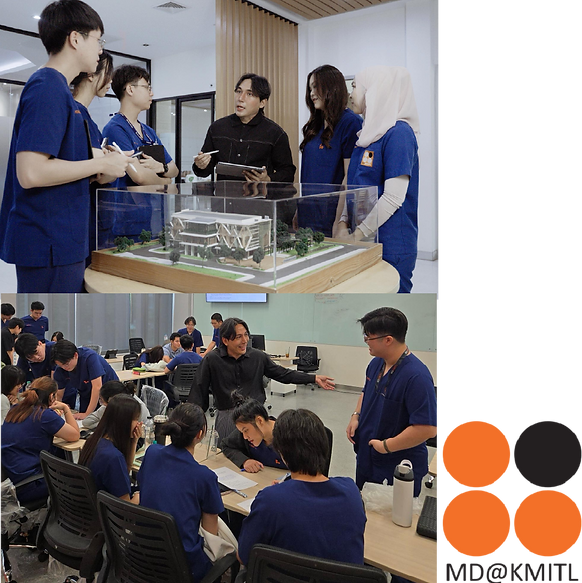
Lecturer at
Faculty of Medicine
KMITL,
Design Thinking for
Healthcare
This year marks my second year teaching at the Faculty of Medicine, King Mongkut’s Institute of Technology Ladkrabang, in the Design Thinking for Healthcare class.
I believe this opportunity comes from my background in healthcare studies at the master’s level, together with my bachelor’s and doctoral training in design. Being trained in both worlds has allowed me to naturally connect design thinking with medical practice and education.
I had a genuinely great time this year. Teaching was rewarding, but learning from future doctors was just as meaningful. Their questions, perspectives, and openness reminded me why interdisciplinary learning matters so much in healthcare education.

Invited Lecture
Master's Program
Faculty of Fine and Applied Arts,
Burapha Unversity
I was honored to be invited by the Master’s Program of the Faculty of Fine and Applied Arts at Burapha University to present and discuss my doctoral research.
My sincere thanks to Dr. Kalayanee Pueknamphol for the kind invitation and warm hospitality. The session concluded with an engaging exchange of perspectives with international students from China, making the discussion both insightful and enriching.

I was delighted to be invited by the Master’s Program at the College of Design, Rangsit University, to share and discuss my research methodology.
Thank you Dr. Minjade Paklapas for the thoughtful invitation and engaging conversation. It was a meaningful opportunity to unpack the research process, exchange ideas, and connect methodology with practice in a design education context.
Invited Lecture
Master's Program
College of Design,
Rangsit University

Workshop with
Faculty of Architecture,
Kasetsart Uniersity

Lecture at
DINDA (Ph.D. in Design Arts), Silpakorn University
